Introduction
Buying a home in the UAE is a milestone that blends excitement with a fair share of complexity. Whether you’re investing in a luxurious Dubai Marina apartment or a serene villa in Abu Dhabi, the journey doesn’t end when you get the keys. One crucial yet often overlooked step before moving in is snagging — a term that might sound simple but carries immense importance for property owners in the Emirates.
In the booming UAE real estate market, where off-plan properties and new developments dominate, snagging has become a homeowner’s shield — ensuring that the dream home you paid for is delivered in perfect condition, without hidden flaws that could cost you thousands later.
What Exactly Is Snagging?
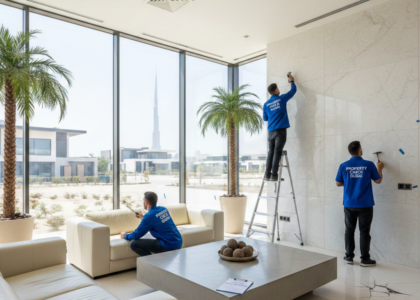
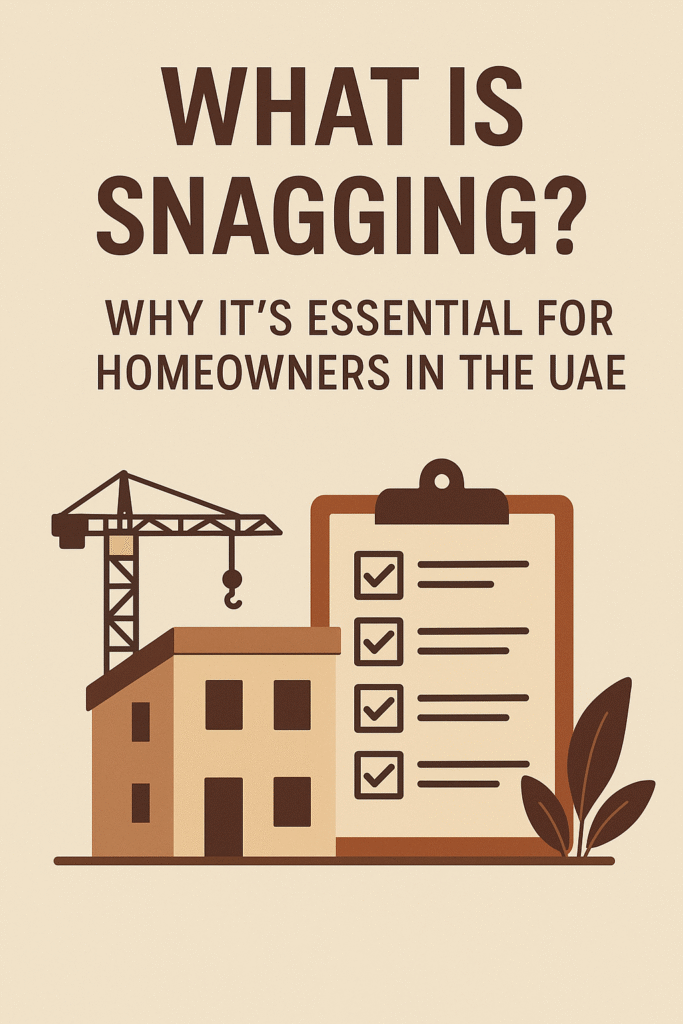
Snagging refers to the detailed inspection of a newly built or renovated property to identify defects, unfinished work, or poor-quality finishes that need correction before the final handover.
These “snags” can range from minor aesthetic issues like paint patches, cracked tiles, or uneven doors, to serious structural or mechanical problems such as water leaks, faulty wiring, or HVAC malfunctions.
In simple terms, snagging is your final quality control check — your assurance that the builder or developer has delivered what was promised under the contract and in line with UAE’s building standards.
The Importance of Snagging in the UAE Context
The UAE’s real estate landscape is one of the fastest-growing in the world. With countless new projects launching every year, developers often race against tight deadlines to hand over properties. This pressure can lead to construction shortcuts, overlooked finishes, and undetected defects.
For homeowners, especially first-time buyers or expatriates unfamiliar with local construction norms, snagging acts as a safety net. It ensures that every detail — from the alignment of your tiles to the performance of your air conditioning — meets the standard you’ve paid for.
In Dubai and Abu Dhabi, professional snagging inspections have become a norm because:
- Developers must comply with Dubai Municipality and Abu Dhabi Quality and Conformity Council standards.
- Buyers have limited time (often 12 months) after handover to report defects.
- The warranty and defect liability period may expire quickly, leaving the owner responsible for costly repairs.
Thus, snagging isn’t just advisable — it’s essential.
Common Defects Found During Snagging
A snagging inspection covers a property from top to bottom, inside and out. Here are the most common types of issues found in UAE homes:
- Finishing and Paintwork Defects
- Peeling or uneven paint
- Visible brush strokes or bubbles
- Poorly sealed joints around windows or doors
- Peeling or uneven paint
- Flooring and Tiling Issues
- Uneven tile placement
- Hollow-sounding tiles (indicating poor adhesion)
- Cracks or gaps between tiles
- Uneven tile placement
- Plumbing Problems
- Leaks in bathrooms or kitchens
- Blocked drains
- Low water pressure or inconsistent temperature
- Leaks in bathrooms or kitchens
- Electrical and Lighting Faults
- Non-functional sockets or switches
- Flickering lights or loose connections
- Inadequate grounding or circuit issues
- Non-functional sockets or switches
- HVAC (Air Conditioning) Concerns
- Noisy or underperforming units
- Poor ventilation
- Faulty thermostats
- Noisy or underperforming units
- Carpentry and Joinery
- Misaligned cabinet doors
- Rough edges or unfinished woodwork
- Loose handles and hinges
- Misaligned cabinet doors
- Exterior and Structural Snags
- Cracks in walls or ceilings
- Poor waterproofing
- Improper balcony drainage
- Cracks in walls or ceilings
Even seemingly small issues can compound over time, leading to major maintenance headaches — especially in the UAE’s hot and humid climate where building materials expand and contract rapidly.
Why Homeowners Should Hire Professional Snagging Inspectors
While you can perform a basic visual check yourself, professional snagging inspectors bring technical expertise, specialized tools, and a trained eye that can spot hidden problems most people miss.
Here’s why hiring a snagging company in the UAE is worth every dirham:
- Expertise and Experience
Professionals understand UAE building regulations, MEP (Mechanical, Electrical, and Plumbing) systems, and finishing standards. - Use of Technology
Thermal imaging cameras, moisture meters, and laser levels help detect concealed issues like leaks, heat loss, or misalignment. - Detailed Reporting
Inspectors provide a comprehensive snagging report — often with photographs, severity ratings, and repair recommendations — which you can present to your developer for rectification. - Negotiation Advantage
A documented snagging report gives homeowners leverage to ensure that all issues are fixed before payment completion or move-in. - Long-Term Cost Savings
Detecting and fixing defects early prevents expensive repairs later, preserving both your home’s value and your peace of mind.
When Should Snagging Be Done?
Timing is everything in snagging. Ideally, you should schedule it:
- Before Handover: This allows you to raise defects with the developer before final acceptance.
- Immediately After Handover: If pre-handover snagging isn’t possible, conduct it within the warranty period (usually 12 months).
- Post-Renovation: If your property has undergone significant remodeling, snagging ensures contractors met the agreed specifications.
Some homeowners even opt for mid-construction snagging, where inspections are conducted during various build stages to catch errors early.
Legal and Developer Obligations in the UAE
Under UAE real estate law, developers are bound by certain warranties and obligations:
- Defect Liability Period (DLP): Usually one year after handover, during which the developer must repair or replace defective items.
- Structural Warranty: Developers are responsible for structural defects for up to 10 years (as per Dubai Law No. 6 of 2019 concerning jointly owned real property).
If you identify issues through snagging within these periods, the developer is legally required to fix them at no cost to you. Having a professional snagging report strengthens your case if disputes arise.
The Snagging Process Step-by-Step
- Appointment: Hire a licensed snagging company in the UAE.
- Inspection: Experts visit the property and conduct a thorough room-by-room check.
- Report Generation: You receive a detailed snagging report (digital or printed).
- Developer Coordination: Submit the report to the developer to rectify defects.
- Re-inspection: After repairs, inspectors revisit the property to confirm all issues are resolved.
This structured process ensures transparency and accountability, both of which are vital in high-value real estate transactions.
Benefits of Snagging for Homeowners
- Protects your investment by ensuring quality assurance
- Prevents financial losses due to hidden defects
- Boosts property resale value
- Ensures compliance with UAE safety and building codes
- Provides peace of mind before moving into your new home
Ultimately, snagging transforms your property purchase from a risky gamble into a secure, well-documented transaction backed by professional evaluation.
Conclusion
Snagging might seem like a small step in the grand process of buying a home, but in reality, it’s the final safeguard between you and future headaches. In the UAE’s vibrant but fast-paced property market, where speed sometimes trumps precision, snagging ensures your home lives up to its promise — flawless, functional, and future-proof.
For homeowners and investors alike, this is not an optional luxury; it’s an essential layer of protection that secures your comfort, your money, and your trust in the property you’ve chosen to call home.